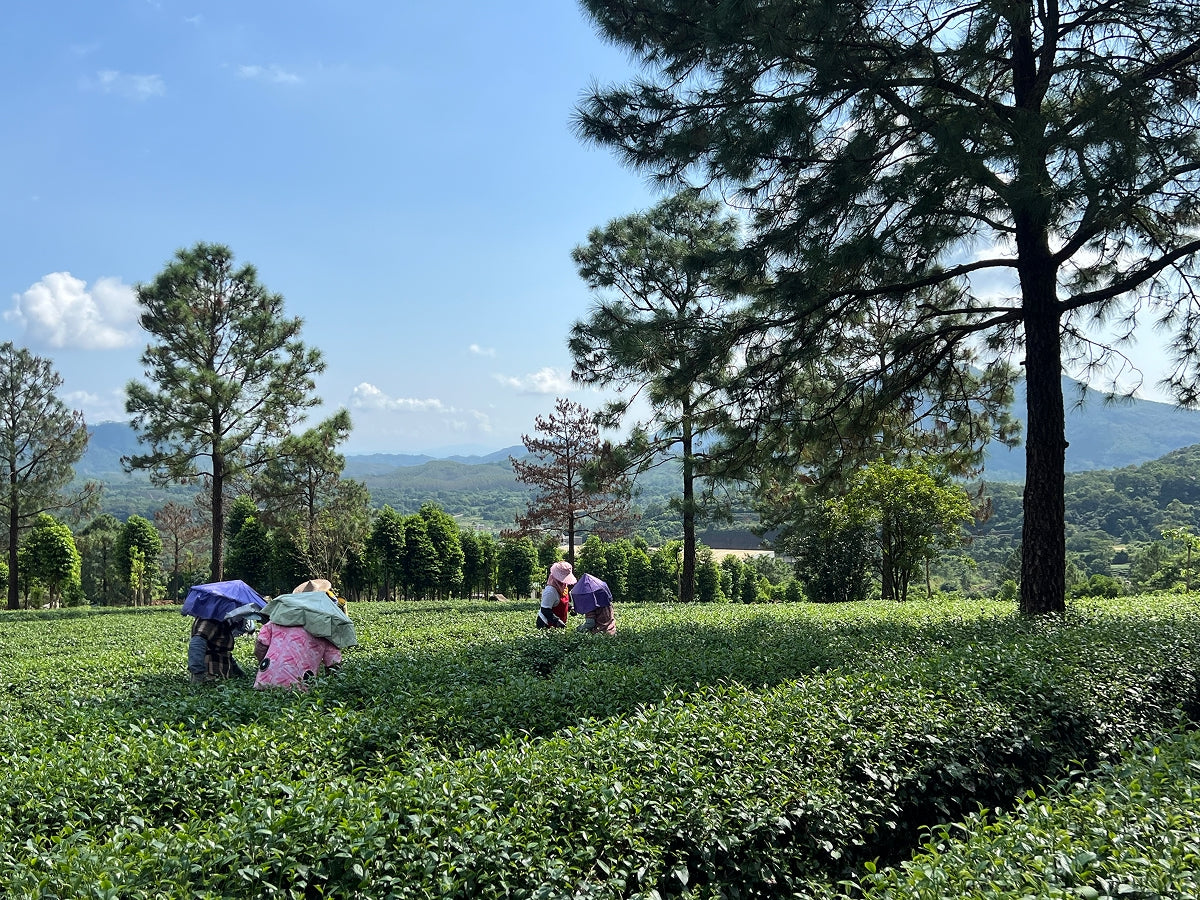
Anxi Oolong Tea (Tie Guan Yin)

Anxi oolong tea is a traditional oolong from Anxi County in Fujian, China, best known for Tie Guan Yin (Iron Goddess of Mercy). Each year, we work with local tea producers to select quality batches of Tie Guan Yin across different harvest seasons and processing styles, reflecting the diversity of this classic oolong tradition.

Skip to results list

Active filters:

4 items

Filter

Active filters:

  • Tie Guan Yin Tea (Ti Kuan Yin / Iron Goddess) – Classic

  • Tie Guan Yin Tea (Ti Kuan Yin / Iron Goddess) – Autumn Harvest

  • Fujian High Mountain Oolong Tea

    Fujian High Mountain Oolong Tea

    Taiwanese Variety

    $39.00
  • Tie Guan Yin Oolong Gongfu Tea Sachets – High-Grade

    Tie Guan Yin Oolong Gongfu Tea Sachets – High-Grade

    Premium Loose-Leaf Oolong Tea

    $11.00

Signature Teas

View all

About Our Anxi Oolong Tea Collection

Our Anxi oolong tea collection centers on Tie Guan Yin, bringing together teas from different harvest seasons and processing styles. The selection includes spring and autumn Tie Guan Yin, with different processing styles and formats represented across the collection.
Although Tie Guan Yin teas share a common name and often a common cultivar background, the finished teas can vary considerably. Harvest season, growing conditions, oxidation, roasting, and other processing decisions all contribute to differences in aroma, flavor, body, and mouthfeel. Rather than presenting one fixed profile as the definition of Tie Guan Yin, this collection reflects some of the different ways this classic oolong can be made and enjoyed.
In the sections below, we explore the origin and history of Anxi Tie Guan Yin, the meaning behind its different names and spellings, how season and processing shape the finished tea, and practical guidance for tasting and choosing Tie Guan Yin. This context can help you better understand the Anxi oolong tradition and distinguish among the Tie Guan Yin teas offered by Chinese Tea Group.

The Origin and History of Anxi Tie Guan Yin

The Origin of Anxi Tie Guan Yin

Tie Guan Yin is one of the best-known oolong teas from Anxi County in southern Fujian, China. Anxi is an important center of southern Fujian oolong tea production and the historical home of Tie Guan Yin.
Tea is cultivated across different mountainous areas of Anxi, where local growing conditions and generations of tea-making practice have shaped the region's oolong tradition. Within this tradition, Tie Guan Yin became the tea most strongly associated with Anxi and remains central to Anxi's identity as a tea-producing region.

Anxi County and the Development of Tie Guan Yin

The history of Tie Guan Yin in Anxi is generally traced to the Qing dynasty (1644–1912), with traditional accounts placing its emergence in the 18th century. Traditional accounts differ on how the tea first emerged. One well-known story credits Wei Yin, a tea farmer from Xiping in Anxi, who is said to have discovered the tea after a dream and named it after Guanyin. Another attributes its discovery to Wang Shirang, a scholar from Anxi, who is said to have later presented the tea to the Qianlong emperor. These accounts are best understood as traditional explanations rather than documented history, but they reflect how closely the tea's identity is tied to Anxi.
Within Anxi, areas such as Xiping, Xianghua, and Gande are known for tea production, with differences in local growing conditions and tea-making practices contributing to variation among teas. From its origins in Anxi, Tie Guan Yin gradually became more widely cultivated and produced, developing into one of the region's most recognized oolong teas.
Over time, the reputation of Tie Guan Yin also helped bring wider recognition to Anxi tea. The relationship between Anxi and Tie Guan Yin therefore extends beyond geographical origin: the tea became closely connected with the tea-making tradition and identity of the region itself.

From Anxi Tea to a Recognized Chinese Oolong

As Tie Guan Yin became more widely known, it reached tea drinkers beyond Fujian and eventually overseas. During the late twentieth century, its production and market presence expanded significantly, while different styles of Tie Guan Yin gained popularity among a broader range of tea drinkers.
Understanding Anxi Tie Guan Yin therefore begins with its place of origin rather than with any single aroma or flavor description. Teas from this tradition can differ according to harvest and production while still sharing their historical connection with Anxi. These differences become important when comparing the Tie Guan Yin teas available today.

Understanding Tie Guan Yin: Cultivar, Tea Name & Anxi Origin

What Is Tie Guan Yin?

Tie Guan Yin is both the name of a tea plant cultivar and a widely used name for oolong tea made from that cultivar. The cultivar and the tea tradition associated with it are historically rooted in Anxi County, Fujian, where Tie Guan Yin became closely associated with southern Fujian's oolong tradition.
This distinction between cultivar and tea name is useful when understanding Tie Guan Yin. The cultivar provides the plant material, while the character of the finished tea is also shaped by where it is grown and how it is made. As the Tie Guan Yin cultivar spread beyond its historical home in Anxi, teas bearing the Tie Guan Yin name also came to be produced in other growing areas.

Anxi Tie Guan Yin vs. Tie Guan Yin: What's the Difference?

Although the two terms are closely related, Tie Guan Yin and Anxi Tie Guan Yin do not necessarily communicate exactly the same information.
Tie Guan Yin can refer to the cultivar itself or to oolong tea made from the Tie Guan Yin cultivar. The cultivar is not limited to Anxi and can be cultivated in other tea-producing areas. For this reason, the name “Tie Guan Yin” alone does not necessarily establish that a tea was grown and produced in Anxi.
Anxi Tie Guan Yin, by contrast, identifies Tie Guan Yin specifically in connection with Anxi County, its historical place of origin and the tea-making tradition that developed there. This geographical distinction can be useful when comparing teas sold under the broader Tie Guan Yin name.

Why Is It Called Tie Guan Yin?

Tie Guan Yin is commonly translated into English as Iron Goddess or Iron Goddess of Mercy, with Guanyin referring to the bodhisattva Guanyin in Chinese Buddhist tradition.
Traditional explanations for the “iron” (tie) in the name vary. Some associate it with the dense, weighty character of the finished leaves, while other explanations are connected with traditional stories about the tea's discovery and naming. Because these accounts vary, the name is better understood as part of the tea's cultural tradition rather than as a literal description of one required characteristic.
The different English translations likewise refer to the same Chinese name rather than to separate types of Tie Guan Yin.

Tie Guan Yin, Tieguanyin, Ti Kuan Yin or Tie Kuan Yin?

Tie Guan Yin is the pinyin-based spelling used throughout this collection, while Tieguanyin is also commonly written as one word. In older English-language tea literature and the international tea trade, you may also encounter spellings such as Ti Kuan Yin and Tie Kuan Yin.
These spellings generally refer to the same Chinese tea name, Tie Guan Yin, rather than to different cultivars or grades of tea. Likewise, English names such as Iron Goddess Tea and Iron Goddess of Mercy are translations or interpretations of Tie Guan Yin, not separate tea categories.
When comparing Tie Guan Yin teas, the spelling on the label is therefore less important than details such as origin, harvest season, and processing style. These details provide more useful guidance when distinguishing among the Tie Guan Yin teas in this collection and choosing according to your own preferences.

How Season and Processing Shape Tie Guan Yin Oolong Tea

How Season and Processing Shape Tie Guan Yin

Even when Tie Guan Yin teas share the same cultivar and place of origin, they can develop noticeably different characteristics. Harvest season and processing choices are two important reasons for this variation, making them useful points of comparison when choosing among different Tie Guan Yin teas.
Rather than expecting one fixed aroma or flavor profile, it is more useful to consider how season, oxidation, roasting, and shaping contribute to different expressions of Tie Guan Yin oolong tea.

Spring vs. Autumn Tie Guan Yin

Spring and autumn are two important harvest seasons for Tie Guan Yin in Anxi. A traditional saying often summarized as “Spring Water, Autumn Fragrance” associates spring tea with the character of the liquor and autumn tea with more pronounced fragrance.
This saying is useful as a traditional point of reference, but it should not be treated as a fixed rule. Weather, growing conditions, harvest timing, leaf quality, and processing can all influence the finished tea. A spring Tie Guan Yin does not necessarily have one required flavor profile, nor is an autumn Tie Guan Yin defined only by its aroma.
For tea drinkers, harvest season is therefore best understood as one useful point of comparison rather than as a simple indication of quality.

How Oxidation and Roasting Shape Tie Guan Yin

During processing, stages such as withering, tossing and turning (zuo qing), and controlled oxidation help develop the character of Tie Guan Yin oolong tea. How these stages are managed can influence the aroma, flavor, body, and mouthfeel of the finished tea.
Roasting adds another dimension. Some Tie Guan Yin is finished with relatively light roasting, while other styles receive more substantial roasting. The interaction between oxidation and roasting contributes to different expressions of the tea, and neither a lighter nor a more roasted style should automatically be considered better.
These processing differences help explain why two Tie Guan Yin teas from the same region—or even the same harvest season—can still taste noticeably different.

Why Tie Guan Yin Leaves Are Often Tightly Rolled

Tie Guan Yin is commonly shaped into compact, tightly rolled leaves during processing. Traditionally, repeated wrapping, rolling, and shaping—often associated with a cloth-wrapping technique known as bao rou—help create the characteristic rolled appearance of many Anxi oolongs.
This shaping tradition also has historical connections with Taiwan. Early Taiwanese oolong production drew on tea plants, knowledge, and processing methods introduced from Fujian, while Taiwanese tea makers later developed and refined their own wrapping and rolling techniques. These methods contributed to the tightly rolled and semi-ball-shaped forms now common among many Taiwanese oolongs, particularly high-mountain teas, although other Taiwanese teas, such as Wenshan Baozhong, retain more elongated leaf forms.
While regional methods evolved in their own ways, this connection reflects part of the broader historical relationship between the oolong-making traditions of Fujian and Taiwan.
This form also provides a visible contrast with some other regional oolong traditions. While Tie Guan Yin is commonly tightly rolled, Wuyi Rock Oolong Tea and Phoenix Dan Cong Oolong Tea are generally made in more elongated, strip-like leaf forms. These differences reflect distinct regional approaches to processing rather than a hierarchy of quality.
Leaf shape alone does not determine the quality of an oolong tea. When brewed, tightly rolled Tie Guan Yin leaves gradually open, allowing the leaf material and aspects of its handling and manufacture to be observed more clearly.
Understanding these differences provides useful context when tasting, comparing, and choosing among different Tie Guan Yin teas.

How to Taste & Choose Anxi Tie Guan Yin

A Practical Guide to Tasting and Choosing Anxi Tie Guan Yin

When tasting Anxi Tie Guan Yin, consider the aroma, flavor, body, mouthfeel, aftertaste, and how the tea develops across multiple infusions. Rather than looking for one required characteristic, pay attention to whether these qualities feel clean, balanced, and well integrated in the individual tea.
Harvest season and processing style provide useful context, but they should not replace tasting the tea itself. Ultimately, the most useful comparison is how the individual tea performs in the cup and whether its overall character suits your preferences.

Aroma and Flavor

Tie Guan Yin can express a wide range of aromas and flavors. Floral, fruity, fresh, sweet, roasted, and other characteristics may appear, but these are possible expressions rather than a checklist that every Tie Guan Yin must match.
When tasting, consider whether the aroma is clean and distinct, how naturally it connects with the flavor of the liquor, and how both develop across successive infusions. A strong fragrance alone does not necessarily indicate a better tea, just as a more subtle aroma does not necessarily indicate lower quality.

Body, Mouthfeel and Aftertaste

Beyond aroma and flavor, pay attention to the structure of the tea in the mouth. The liquor may feel lighter or fuller, softer or more structured, depending on the individual tea.
Consider whether the mouthfeel is clean and comfortable, whether the flavor remains after swallowing, and how the aftertaste develops. These qualities can be particularly useful when comparing teas that may initially appear similar from their aroma alone.
No single texture or aftertaste defines a good Tie Guan Yin. What matters is how these elements work together and whether the overall expression suits your preferences.

Choosing Between Different Tie Guan Yin Teas

When choosing among Tie Guan Yin teas, begin with objective information such as origin, harvest season, and processing style, then use tasting to understand how those differences are expressed in the cup. These details are useful for comparison, but they should not be treated as a ranking system: one season or processing style is not automatically superior to another.
At Chinese Tea Group, we recognize that taste is personal. Rather than defining one flavor profile as “best,” we focus on clearly identifying details such as origin, harvest season, and processing style, giving you reliable information to compare different Tie Guan Yin teas and choose according to your own preferences.
Whenever possible, taste the tea across several infusions rather than judging it from the first cup alone. How the aroma, flavor, mouthfeel, and aftertaste develop from one infusion to the next can provide a fuller picture of the individual tea.